Blog

  • More Precious Than Rubies, Part 3

    Every September in Toronto, there is an event entitled “Word on the Street” which brings together authors, bookstores, writing organizations, and magazine companies in an open-air venue.

    For a little over $400, self-published authors can rent a booth and attempt to sell their books.

    I tried my hand at this on September 22, 2013, bringing along copies of MPTR.  I sold a paltry nine copies although there were a number of people who took away bookmarks that advertised my novel.

    I was still teaching in those days and one of the administrative assistants from a school I had worked in purchased the book to put in her school’s library.  I was touched by that but wonder if, by now, the book has been removed due to being outdated.

    When we expose our books and our reasons for writing them to people, we can always assume that not everyone will support us.  When I explained to one man what MPTR was about, he went off on a tangent, talking how corrupt the world was, that the ice-caps were melting in the Arctic, that people were destroying the planet.  I didn’t see any connection between my book and his concerns and figured that he just needed someone to absorb his anger.  At one point, he said, “Nobody is listening,” to which I responded, “I am listening.”  And I was.

    My book went “international” in July 2014 when I visited one of my favourite destinations, San Miguel de Allende in Mexico.  I brought along copies of the book and left one for my favourite waiter at my favourite restaurant so that he could give it to his son.  I took another to a used bookstore called “Garrison and Garrison” and left it for the owners to sell.  I didn’t want the money; just the recognition.  The person I spoke to was delighted and said that she always tried to flaunt books by local authors.  Since I visit SMA numerous times, we considered myself a “local” author.

    Also in July, I paid to have my book reviewed by some prestigious book reviewers.  Some reviews were disappointing; some encouraging.  I will get to this in my next blog.

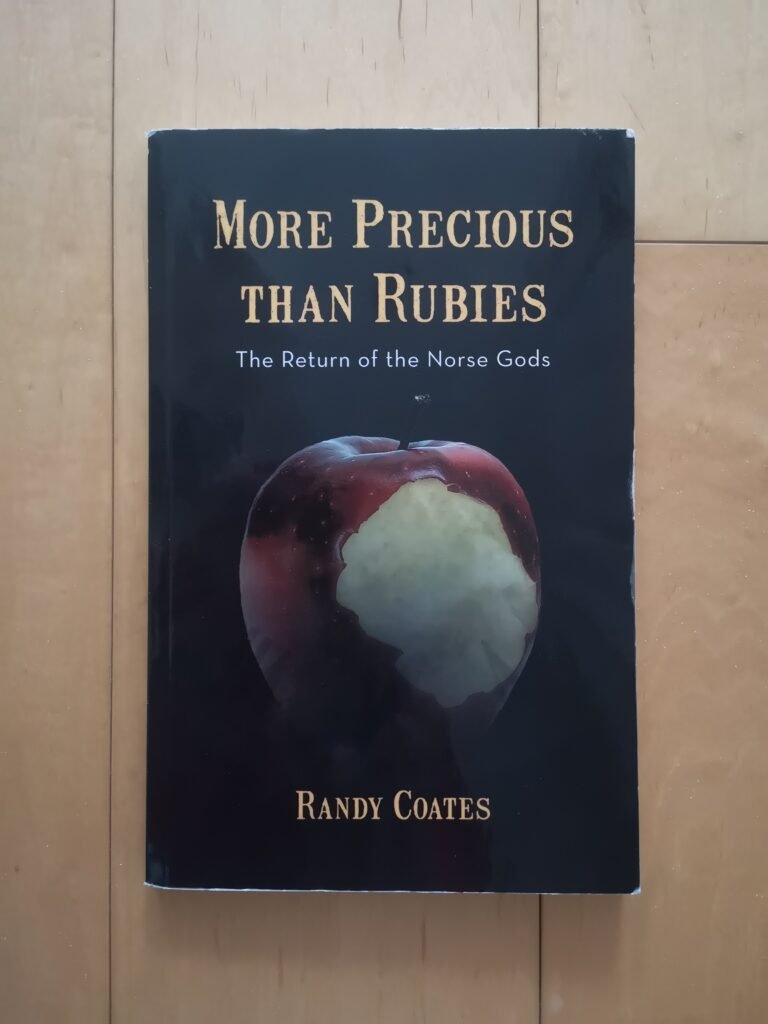
    The front cover of my book:
    mde
  • More Precious Than Rubies, Part 2

    More Precious Than Rubies was still unpublished in 2010. I wavered between feelings of optimism that it had merit and feelings of pessimism that it lacked cohesion and punch.

    I signed up for a workshop at Humber College in which a group of aspiring writers submitted the first page of their novels and had it critiqued by the writing staff at the college. I was in a large room of fellow writers and our first pages were read out loud. The authors’ identities were withheld.

    I cannot remember what was said about mine but I don’t recall the comments as being pleasing. One comment I do remember is that every sentence in a piece of fiction must mean something and must be integral in some way to the novel. For example, if one describes the weather as sultry, there has to be a reason that the sultriness is depicted. Does it have some bearing on the narrator’s mood? Something that makes him do an action because of that mood?

    That comment has stuck with me for the past fifteen years. I try not to write sentences simply because they are filler or that I need a specific word count.

    By July 2012, after numerous rejections to have More Precious traditionally published, I got impatient and sent it to iUniverse, an American company that self-publishes work. I spent $2500 which included a designer for the front cover, typesetting, and a team that would help me market the book. This included setting up a webpage for my writing. When I look back upon this endeavour, I believe I moved too quickly. Although the book is available through Barnes & Noble and Amazon, I have come nowhere near making the money I put into its production.

    Not to be discouraged, I tried to market on my own. I reached out to a local Toronto newspaper called The Bulletin and had an article written in September 2012.

    Here is a quotation taken directly from that article: “…Randy Coates has taught students from kindergarten to grade 8 over the past 20 years at various schools around the city. His daily observations inspired him to write.”

    I also consulted the Customer Experience Manager, Reading at Indigo Books in Toronto’s Eaton Centre. She allowed me to sell hard copies of the novel there, a percentage of the profits going to Indigo. I did so on October 13, 2012, and sold eleven copies.

    I meant some interesting people. There was one man who flicked pages of the book and asked questions about it. When I talked about Mr. Theisen being a reincarnation of a Norse God, he said he wouldn’t let his child read anything like this because reincarnation “is not Biblical. It’s a form of witchcraft.”

    “Okay, thanks for looking,” I told him as he walked away.

    Then there was the deaf, Italian woman who needed my pen and paper to communicate to me. She had been a graphic artist in Italy.

    And then people ask writers where they get their ideas?

  • Self-Publishing

    More Precious Than Rubies

    My first real novel, after a couple of juvenile attempts at writing in my twenties, is entitled More Precious Than Rubies. You can read the blurb about it in my listed books.

    The idea for it germinated in 2006. I wrote this in my journal:

    “At the beginning of the school year, a sinister, mysterious new principal comes into the school. Why he replaces the former principal is not explained. He is the member of a diabolical group out to terrorize the world. The members have the power to take away peoples’ lives if others donate part of their lives to save the others.”

    My own experience as an elementary teacher at the time contributed to the concept. I was forty-two during this period of my life. I considered myself late to the publishing business but young enough to get things done. There was still a lot of time. Surely, I would live another forty years.

    I completed writing the novel on September 20, 2007. I was forty-three. I sent it out to a few publishing companies, branding it as a children’s fantasy novel. Fantasy was huge then.

    I began to see how important revision is and how one begins to add things, take away things, alter events in a novel. My book soon became based upon the Norwegian myth in which Iduna keeps guard over an apple grove. The apples grant people youth and vitality and Thiassi wants them for himself. He seeks to gain possession of the grove through his evil ways.

    My brain connected the myth with my novel. I called the principal Mr. Theisen and the book became a modern rendition of the myth.

    By January 9, 2009, I had completed a second draft of the book. Originally entitled The Chosen Ones, it adopted its official title. I started to send it out to the publishing companies.

    I was so naïve.

    More about More in my next blog.

  • Objectives

    Jarrett Rusnak is a Canadian screenwriter who has been an accountant for North American movies and series.  He lives in my building and organizes a group of screenwriters who gather to critique each others’ work.  I am not a screenwriter but Jarrett knows how passionate I am about writing and that I have written a few novels, none of which have been traditionally published.  He invited me to join the group.

    We are a small group and nobody holds back.  Our comments to each other are delivered with honest but friendly remarks.  When we believe that a person’s story needs tweaking, we say so, often backing ourselves up with suggestions about how they can improve their work.

    Recently, I wrote a novel about a school shooting, from which I submitted the first 20 pages to our group.  I was impressed by the amount of comments that people gave me and that guided me in revising my draft.  For those of you starting out in the writing field, you must have a stony resilience.  Be prepared to take criticism; be prepared to know that you might be creating a complete makeover of what you have previously written.  My writing has been rejected countless times and yet I still love to write.  If one can do that, then they are a true writer.

    At last night’s meeting, Jarrett shared with the rest of us some notes about a recent screenwriting workshop he had attended.  The one note that stuck out the most for me is that your leading characters must have an objective:  what do they want to do?  What do they want to accomplish?  And this objective has to be big.  It can’t be as simple as Protagonist A wants to find his lost cat.  There must be an objective that may even be life-changing.  The objective isn’t easily achievable and is impeded by events and antagonists in the story.  The author must be specific about what the objective is and what the consequences are if the objective is not attained.

    Having conflict in a story is vital.  If an objective is reached too easily or without conflict, then the reader will get bored and soon lose interest in your work.

    Interestingly, while Jarrett explained these things to the group, I told him that these very observations were raised in a webinar that I attended a week ago.  The American writer, Jeanne Lyet Gassman, who happens to be a novelist like myself, repeated what Jarrett had heard at his workshop.  One of the comments I remember her saying is that a book is “complete if the protagonist reaches a goal or doesn’t quite but still learns from their journey.”  Also, “solutions should always have a consequence.”

    Jarrett and I have discussed the differences between screenwriting and novel writing but, as you can see, there are many similarities between the two.  What we should all strive for is good writing.  Writing that grips the reader from page one.  Writing that is not chichéed.  Writing that has conflict.

    In a month, I will present to the group my newest revision of the novel about the school shooting.  I anticipate more suggestions about how I can make it better.  Be prepared, everyone.  Writing is not easy. 

    Screenwriter Jarrett Rusnak

  • Starting Again

    It has been almost ten years since I wrote a blog.

    Thanks to Faheem Khan at Tritrix Inc., I have a new, improved website in which I can entertain people and, at best, give them an insight about writing. Whether you are a seasoned writer or one who is new at the craft, I hope that you find my blogs interesting and perhaps even educational.

    A little about myself:

    I can remember, at the age of ten, fifty years ago but who’s counting?, I was lured by the sirens of writing and I have never looked back. People have different hobbies and sometimes we can’t always understand them because they don’t appeal to us. Well, writing was mine. My parents weren’t huge readers but they were proud of me and they watched me write, proud that I was being inventive, creative. They gave me my space and I loved them for that.

    Over the years, I have had periods when words have shot out of me onto the page. I’ve also had my fallow periods and days when I wonder if the effort is worth it. The answer: certainly. When I wrote something I considered “garbage,” I would throw it out. This is no longer the case. For you aspiring writers, here is my first bit of advice. Don’t throw out anything. Put it aside. Let the seed germinate. It will come back to you. I’ve lost count of the times that I have dug out an old story/poem/novel, continued it and completed it.

    I have never been traditionally published. I have had my share of honourable mentions in story-writing contests but there is nothing else beyond those.

    I was quite pleased when, 20 years ago, I was informed by a member of the Toronto Star newspaper that my story was in the top 40 of about 2,000 entries in The Toronto Star Short Story Contest. I still deem that as the best story I’ve ever written and have revised it three times, making it more powerful each time. My second bit of advice to you writers: put your finished products aside and when you feel the need, revisit them and revise them. This could be a week after you wrote the first draft. Could be a month, a year, ten years.

    I was also thrilled to have three of my stories (in different years) given honourable mentions in the Lorian Hemingway Short Story Contest.

    I try to fit in one or two hours a day writing. Easy for me to say since I am retired. Currently, I am working on a novel about a zombie apocalypse, laced with some humour.

    Please join me here in my journey in the world of writing.